

There is perhaps no force more devastating than the violence we inflict upon ourselves.
I still vividly recall the moment—right after vomiting a sushi dinner I believed I didn’t deserve for having eaten too much—facing my own reflection in my bathroom mirror. Blood gushed from my nose. My face, distorted, swollen. The red-veined eyes that stared back at me were those of someone I barely recognized, yet knew intimately. I had come face-to-face with the violent intersection where self-hatred transforms into self-destruction.
“You deserve it,” I told that reflection. “You fat fuck.”
My reflection showed someone who appeared to embody success by every external measure. The veins across my abdomen formed thick lines as they visibly crawled up to my chest. Yet beneath what a classical sculptor might have considered perfection, that old, ever-wrathful voice of self-hatred bubbled up.
I was terrified of myself. Terrified of my own harsh self-judgment and the severe punishment I might inflict for even the smallest mistake. Life became nothing more than surviving the wrath of this ever-watchful side of myself.
Later I’d come to recognize this voice as part of—indeed, a manifestation of—my identity’s underlying architecture that would govern my actions with systematic and mechanical precision for years to come.
I’ve spent quite some time trying to understand what I saw in that mirror. That bloody encounter led to years of painful self-discovery and relentless study, both formally in university and in the less orderly education of my own life.
I feel I owe an account of what I’ve learned. A truth I’ve come to know intimately.
By tracing this story back to its source, I uncovered the invisible architecture governing our lives.
It’s this that I want to share with you.
What I’m about to reveal will transform how you understand personal change.
By the end of this exploration, you’ll discover why your previous approaches failed to move anything in your life, and possess a precise framework for transformation that aligns with your mind’s natural mode of functioning. I’ll also reveal why your identity functions as what I’ve come to call a psychological thermostat, constantly regulating your external reality to match the internal blueprint you hold of yourself.
With this, you will see how identity is the key determinant of which changes feel natural to sustain for “someone like you,” and which feel like something you have to keep forcing for reasons that lie beyond the veil of your knowing—a feeling we’re all familiar with.
You will discover the four-layer world that determines your life’s trajectory and shapes how you live, and finally grasp why willpower alone has never been enough. With this, you’ll learn to become the architect of your own identity rather than its prisoner—once you see how your identity is constructed, you can take a more deliberate part in the shaping of it.
These exact principles enabled my escape from that cycle of torment, allowing me to reach financial freedom, maintain the physical transformation I once believed impossible, and simultaneously pursue the dream path I had long envisioned in both academia and vocation.
The violent civil war that once roared within has now evolved into a sense of alignment, a way of living that feels increasingly like the natural expression of my authentic self—increasingly instinctive, and increasingly true to who I am at the deepest layers of being.
At last, the parts of me that fought ever so fiercely have found a common course, learning to move in the same direction.
The Cruel Physics of Regression
There is arguably no more bewildering experience than watching your carefully constructed transformation crumble before your eyes. Watching all that progress dissolve can make you question more than just the experience itself.
Did you actually change?
It certainly felt that way; you still have all the photographs, trying to remind yourself what it felt like to have it all—when you’d wake up pleased with life.
How are you meant to make sense of a horrible nightmare that remains even after you open your eyes, with no waking world to retreat to?
You had the perfect plan, perfect strategy for execution, and you executed flawlessly. You lost the weight, you built new habits, you began to trust yourself a little—hell, you even felt an actual sense of change emerge. Yet here you are, six months later, with the mirror looking much as it did at the beginning of the journey.
Except now you’re carrying the additional failure.
This phenomenon is not merely frustrating; it is practically universal.
Nearly all of the subjects in a review of 29 long-term weight-loss studies regained their lost weight within five years, with most returning to their initial weight within the first two years. (It’s worth pausing here since it’s easy to forget that behind these averages are real people—people who were likely proud and motivated individuals who took on new lives and actually lost weight. They had every right to believe the weight loss would stay lost permanently. Whatever explains its return deserves more consideration than a passing judgment that they simply “didn’t want it bad enough” or “lacked discipline.” Cringe.)
Despite drastically improving their financial situation, many lottery winners find that their life situation does not improve and often becomes worse after their win.
As for the people who are able to create wealth on their own and sustain it, you can find countless examples of those who are now wealthy but remain miserable. Money has done nothing to ease their fervent hatred for life.
And even the most motivated individuals—those who seem to possess every psychological and physical advantage—repeatedly find a way to sabotage their careers and success.
Reader, what makes you think you’re any different?
I’ve personally witnessed and been inspired by many friends and role models dramatically improve different aspects of their lives. However, in most cases, these transformations proved to be short-lived. Some regained the weight. Others lost the business or watched another relationship fall apart.
Still, what interested me most was their reaction to these issues.
They would simply shrug and say, “I guess I’m just not that type of person.”
How could they resign themselves to something so clearly self-imposed?
How could they watch themselves tumble from the summit of victory without once looking back to ask what had loosened their footing?
It was as though they believed some invisible force had already settled their limits, leaving them only to discover where they lay. (Sartre, somewhere, just lit another pipe in disgust).
The mystery only deepens when we observe that certain people seem immune to this regression, surviving the setbacks and upheavals that had undone so much progress around me. Their transformations stand like fortresses against the erosive forces of time and circumstance.
This puzzled me (and only slightly irritated me). How could I barely sustain something that felt so ordinary for someone else? They became someone new and somehow stayed that way.
So what separates them?
It is all too human to look at what these people do: their habits, their willpower, their circumstances, which is also all too wrong.
The answer is something far more fundamental: their inner world architecture.
Specifically, it lies in understanding how identity functions as a psychological thermostat, regulating every aspect of your external life back to a temperature that was set long before you ever knew anything of it.
Most of us are fighting a war we don’t understand, between the person we’re trying to become and the person we believe ourselves to be. And so we frantically spend our lives adjusting the temperature of the room. We take action, change behaviours, and modify circumstances, while remaining blind to the thermostat that controls all.
We are, in essence, trying to heat a house by holding matches near the thermometer.
The stakes could not be higher.
Your outer, physical world will always regress to match your inner world’s set-point, and whether you know it or not…
*deep inhale*
THAT SET-POINT HAS ALREADY BEEN ESTABLISHED, AND YOU ARE CURRENTLY LIVING UNDER ITS INFLUENCE.
Master this principle, and every other aspect of change becomes dramatically easier. Ignore it, and you’ll remain trapped in cycles of temporary progress and inevitable return.
The Illusion of Action-Based Change
“The definition of insanity is doing the same thing over and over again and expecting different results.”
—Einstein
We live in a culture that worships action. “Just do it.” “Hustle harder.” “Take massive fucking action.”
These mantras saturate our thinking about change, creating the illusion that “behaviour modification” is the path to transformation. This perspective seems quite intuitive, too—after all, we need to act differently to get different results, right?
Right?
Funny.
This way of thinking misses the more important question: who are you becoming in the process?
The result is an epidemic of temporary progress followed by inevitable regression, a cycle so predictable it has become normalized.
The problem is that the action-first approach, something that has regrettably infected our algorithms, treats symptoms while ignoring the underlying condition. This does nothing more than postpone an outcome that only grows more painful with time, akin to taking pain medication for a broken foot and blithely continuing to walk in blissful oblivion as the damage worsens. Sure, immediate discomfort may subside, but the damage only deepens beneath the anesthetic of ignorance.
The deeper, more insidious problem remains unaddressed.
Consider the January gym phenomenon, where every fitness centre becomes a battleground of good intentions as millions of people launch into ambitious workout routines. As weeks pass, you see fewer of them, and by March, these same facilities return to their normal occupancy levels, with only familiar faces remaining.
What happened? Where did everyone go?
Did these people suddenly lose their desire to look better? Or maybe they forgot how to exercise?
The answer is both simpler and more profound: they were attempting to change their actions without changing the soil of identity from which those actions grew.
No plant can flourish in rotten soil that poisons its roots.
They tried to change their actions without changing the identity that motivated and directed those actions. The psyche cannot be fooled indefinitely, nor will it be mocked.
They were attempting to behave like athletes while keeping the inner world of a fat person.
The cognitive dissonance eventually became unbearable as they breached the perimeter of their old self. Alas, their psychological thermostat kicked in to restore equilibrium.
My Violent Dance with Self-Creation
Between eighteen and twenty-one, this dynamic became painfully familiar to me. During this particularly intense period, the discipline I brought to training, nutrition, and recovery found its expression in a physique that drew admiration and recognition throughout my city. It was quite cool to see what I had accomplished.
Yet what I had built with such devotion became the wellspring of my suffering, lending those years something of the cruel irony of a Greek tragedy, where triumph prepares the ground for undoing.
Those close to me questioned my dedication to “fitness” when it seemed to be costing me my well-being. I would retreat, defensively shrugging off their concerns by claiming “because I want to,” followed by an indifferent “why do you even care?”
Beneath that reply lay a truth I had yet to understand—one that would eventually come into focus through my formal studies in neuropsychology and philosophy, alongside my independent exploration of Buddhism, Daoism, and Jungian psychology: I was a mere prisoner of the very actions I believed I authored.
This realization led me to identify two competing versions of myself, with my actions as the violent manifestation of the war waged between these identities—identities perpetually locked in mortal combat for control over my physical being.
The first, which I’ll call DS (Dark Side), demanded nothing less than physical perfection through relentless surveillance and punishment. And it worked—I achieved physical prowess and strength beyond anyone I knew in my city. Indeed, I was among the rare few globally to achieve this level of physical development at my age.


The second, FUL (Fat, Ugly Loser), carried the deeper conviction that I was fundamentally unworthy of the body DS was trying to build. The battle between the two manifested as classic eating disorder cycles: binge (FUL), purge (DS)—whether through three hours of cardio or forcing myself to vomit—and the cycle would repeat.
This violent battle would go on for weeks, then months, with me caught in its crossfire and left to bear the full weight of its consequences. Gradually, I came to recognize how reliably it ended with the same result.
FUL always won.
DS was able to hold down my weight temporarily, but inevitably I would fall into my annual pattern—gaining 20 pounds in just three days (yes, you read that correctly) through extreme binging, typically around mid-July. From August until mid-April, I existed as FUL, consumed by self-hatred.
This led to a realization that marked a turning point in my life: FUL wasn’t just a part of me; he was my core identity.
In my deepest self-conception, I was and believed myself to be FUL. This fundamental (and previously unconscious) belief constituted the basic setting that governed who I believed myself to be at the most basic level.
Through this finding, what I discovered was a four-layer structure governing every aspect of our existence—a blueprint hidden beneath the surface of our consciousness. This underlying design determines whether our efforts at change take root or wither. Once you understand how these layers interact, you can begin to rebuild your inner world deliberately rather than remaining trapped within it.
The Architecture of Lasting Change
Following years of study in my dual major and painful self-examination through meditation, journaling, and other introspective practices, I’ve come to understand the structure that undergirds lasting change (what we might call a “real transformation,” since change that does not last is merely decorative). Achieving this sort of change requires recognizing a fundamental hierarchy within what we might call your “inner world.”
The so-called “outer world” is simply what is currently visible in your physical reality.
This would include things like your health and vitality, your physique, the amount of money sitting in your bank account right now, the emotional weather and quality of your relationships, today’s timetable and schedule, where you currently go to work or study, your immediate environment as you read this, all the things you own, and the opportunities that seem to manifest in your own life.
As for the inner world, it is composed of four distinct layers. The lower layers give form and structure to those above.
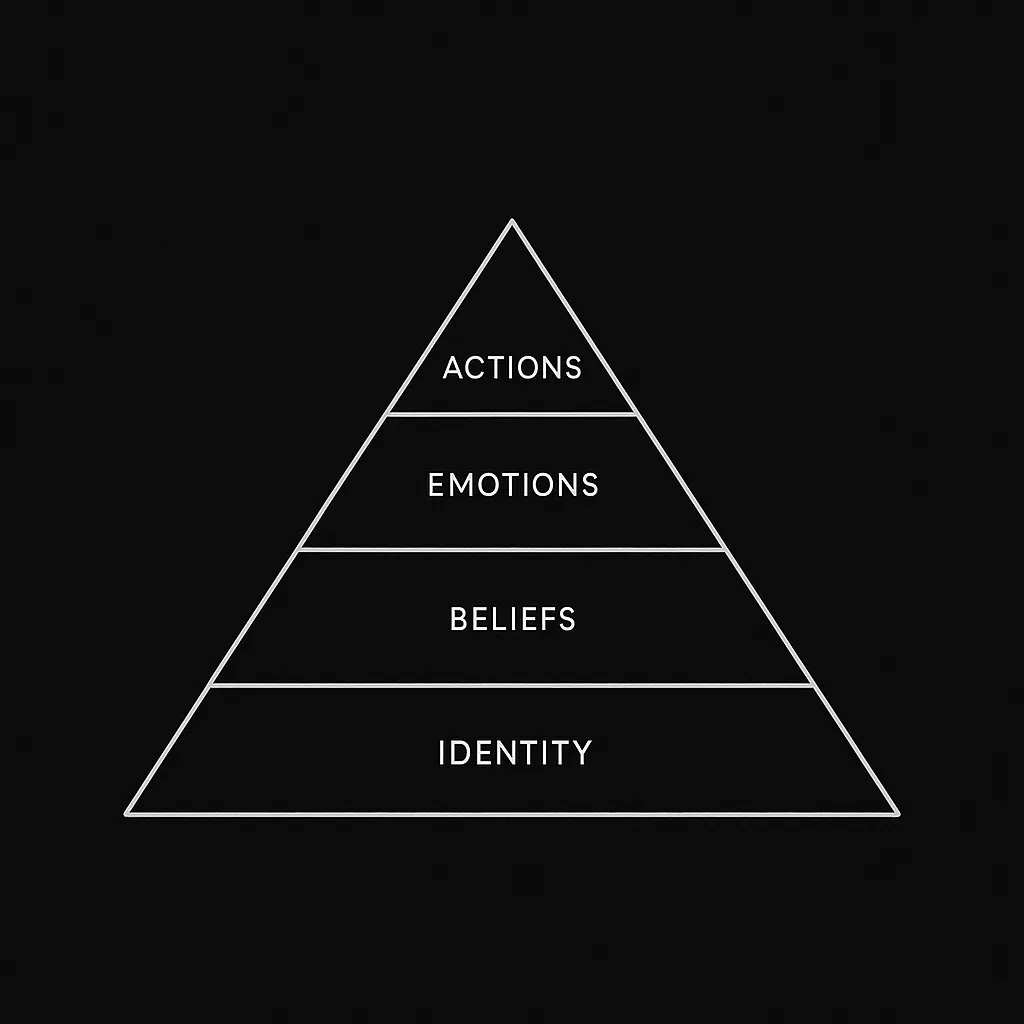
Identity: The foundational layer. This is your self-concept, formed by your core beliefs about who you fundamentally are. It acts as the psychological source code from which everything else stems, determining what feels natural, deserved, and sustainable for someone like you. It is the story you hold yourself to—who you are to yourself. Your life automatically reorganizes itself to provide evidence for or against this core story.
Some core identity statements might include “I am intelligent,” “I am never good enough,” “I am charismatic,” “I’m not funny,” or “I’m useless.” Important to note is that the majority of these beliefs are unbeknownst to the person whose identity they define.
Take a moment for honest self-inventory. Ask yourself: “Who am I, really?”
Are you hardworking or avoidant? Resilient or fragile? Knowledgeable? Do you complete what you start? Do you support your family or burden them? Do you procrastinate? Do you maintain healthy eating habits? Do you read regularly? Are you dependent on porn, drugs, food, or your phone?
Beliefs: These are the rules and assumptions you hold about yourself and the world around you that flow downstream of identity. Beliefs are the raw material that shapes what feels possible and forms your framework for interpreting experiences, alongside identity (I’ve called this the “identity-belief” scaffold in the past). Further, the belief layer also establishes the parameters within which you make decisions.
Belief statements may look like “I am unfortunate due to my circumstances and upbringing,” “Money is hard to come by and requires constant struggle,” or, after experiencing heartbreak, “I must always keep my guard up, or I’ll get hurt again.”
Emotions: The felt experiences and signals that arise from your identity and beliefs, which, when present, lend momentum to what otherwise might remain an idea about ourselves or the world.
Emotions provide the impetus to act or not act, communicate what’s important to you, shape your decisions through intuitive guidance, and arguably serve as the best feedback mechanisms for describing and evaluating situations. Importantly, they can become powerful catalysts for action or change, whether positive or negative.
Consider how emotions directly emerge from our belief and identity layers (recall the identity-belief scaffold).
If my identity rests on “I’ll never be good enough,” and from it follows the belief that “Criticism exposes how inadequate I really am,” an ostensibly minor comment can feel like confrontation, awakening the emotion of shame. But if I understand myself as “Someone with a fertile mind, capable of learning,” and believe that “Being corrected gives me an opportunity to improve,” I can receive the same criticism as constructive feedback.
I remain baffled by the idea that “emotions are random reactions,” particularly when the same event can evoke entirely different responses in different people solely because of their beliefs and identities that constitute their inner world. Properly understood, they can provide lucid reflections of our underlying identity-belief architecture.
Actions: The visible surface behaviours that result from the three underlying layers. The most superficial yet commonly overemphasized element in transformation.
Recognizing how much precedes action, we can now better understand that behaviours are nothing more than the temperature of a room, and will ineluctably return to whatever temperature the thermostat—your identity—has been set to. Indeed, the temperature of a room can perhaps be temporarily modified by opening a few windows. But the windows cannot remain open indefinitely, and the thermostat will promptly resume its work as set. So it is with behaviour: any change I try to maintain will revert to what is congruent with my identity, stabilizing only when the foundational layers beneath are properly aligned.
Any hope of changing what we habitually and permanently do requires us to venture beyond the visible act itself, voyaging into the weary conditions that continue to bring it about.
This explains that painfully familiar pattern to anyone who has undertaken the endeavour of change seriously: temporary victory followed by inexorable regression.
It’s also worth noting that the relationship between these layers is neither random nor democratic.
Identity shapes beliefs. From this identity-belief interaction arise emotions. From those emotions, actions.
Yet when we attempt to transform ourselves, we reverse the script, believing that starting with what we do, rather than who we are, will somehow lead to a new life. Our precious efforts remain concentrated at the surface. The underlying architecture remains undisturbed.
So, your outer world is not a cause but an effect.
It is the inevitable manifestation of your inner world’s architecture.
Given sufficient time, the outer world of visible results will always conform to the inner world of identity.
Becoming the Architect
“As within, so without.”
—The Kybalion
The tattoo written in Arabic on my forearm carries the extended version of this quote. A reminder that it is my internal reality that creates my external one. Change the world within, and the geometry of the world beyond must follow, for these worlds are bound by an arithmetic of their own.
Attempt to change the outer while leaving the inner unaltered, and you will face the resistance of something far greater than yourself—a vast “servant mechanism” living in your unconscious depths, fixated upon a singular goal like an unrelenting guided missile hurtling through the sky until impact (thank you, Dr. Maltz).
Understanding this changed my life. I was seventeen, standing in my bedroom as the esoteric “mindset module” of an e-commerce course played on my older sister’s old, second-hand MacBook. The realization raised the hair on my skin, just as they are now, writing these words.
When you develop the ability to consciously restructure these psychological layers, you witness what can only be described as reality-bending consequences. You are, in essence, reshaping reality. And not merely in your head, but in the concrete manifestation of your physical world.
This also illuminates why traditional approaches to change feel like a perpetual battle against invisible forces. One does not merely confront circumstances or habits, but literally wages war against the very foundation of her psychological architecture. The battle feels endless as she tries to sustain the behaviours that promise the good life, yet those behaviours remain fundamentally at odds with her identity. It is this instability that exhausts her, not the actions themselves.
I have discovered an alternative approach, something I now call Identity-First Transformation.
Traditional methods ask you to fight your psyche’s innate drive for consistency and believe that the result of such a battle will lead you to your desired goal. This method harnesses the same drive on your behalf, drawing upon the golden nectar of the unconscious.
The work begins beneath the visible surface, with self-concept, and cascades through beliefs and emotions until it ultimately finds expression in action. No longer does change become a battle against yourself. Instead, it unfolds with a kind of psychological inevitability.
The Terrarium
I want you to imagine a giant room in a zoo (a.k.a a terrarium) capable of hosting any ecosystem imaginable. Animals and life forms are free to roam in and out of this room as they wish.
This space features climate control, regulated by a central thermostat.
Here, the thermostat represents your inner world, calibrating the precise temperature of your existence. The ambient temperature of the terrarium determines which organisms thrive or perish within this environment. These life forms represent the conditions of your outer world—your relationships, finances, physical health, and opportunities.
Just as these organisms rely on particular environmental conditions to emerge and to thrive, so do the conditions of your outer world. It is your innermost reality—the precise temperature dictated by the terrarium’s thermostat—that creates and limits the conditions of your physical world in which you find yourself.
The Ecosystem Hierarchy
Taking this metaphor further, let us classify various kingdoms of life that reside in this ecosystem and map them to the different domains of your outer world. The order in which they appear herein reveals the order of transformation that you experience in your life:
Microbes: These tiny creatures represent the basic essentials in your life, such as adequate sleep, nutrition, and exposure to sunlight. Like the invisible microbiome that forms the foundational soil in which plants take root, their effects unfold gradually, enriching the soil from which the rest of your life grows.
Plants: The slower-growing structures of your life—your routines and consciously chosen values. These provide foundational support and routine in your daily life, just like plants transform sunlight into energy that sustains the entire ecosystem. Through their consistent presence and gradual development, they create stability that makes higher achievements possible.
Fungi: By breaking down dead or decaying matter in an ecosystem, fungi allow for the release of essential nutrients for other organisms. Likewise, certain emotional and psychological behaviours—journaling, psychotherapy, difficult conversations, forgiveness—can help you heal and close a chapter by breaking down stale narratives and putrid feelings. This helps prevent a buildup of emotional and psychological toxins in your psychological ecosystem. Indeed, what might have burdened you may prove to be nourishment for positive growth and new beginnings.
Insects: Before larger changes appear, there are insects: the immediate, moment-to-moment signals in your ecosystem. These quick, transient elements respond almost immediately to temperature changes. Your notifications ping differently. Cravings shift in intensity. Small victories begin to accumulate—evidence that your thermostat adjustment is taking effect. Just as insects rapidly proliferate and vanish as the climate fluctuates, these evanescent signals offer the earliest confirmation that your inner world is beginning to transform.
Animals: The visible manifestations of your transformed inner world. The outcomes and people. They arrive last. Small creatures show up first (minor achievements, improved social interactions and conversations); apex animals (that sick fucking car, a partner who matches you from a fundamental values standpoint, unbreakable, charismatic confidence) migrate only into a stable habitat. Importantly, they stay only if it remains stable.
At -40°C, penguins, cold-water fish, and hardy moss thrive. In other words, survival-oriented elements do well: defensive relationships built on mistrust, habitual scarcity thinking, stress eating and fast-food indulgence, and hypervigilant protective behaviours.
When you turn the dial of the thermostat upward to +40°C, these cold-adapted species don’t simply vanish, nor does tropical abundance immediately manifest.
Instead, the original inhabitants will gradually thin out as the temperature rises; old patterns dying away as new possibilities take root.
There exists an inevitable lag between adjustments to your inner world and their actual manifestation in your outer world (external physical reality).
This is perhaps the most important thning you can take from this newsletter.
Consider your home’s climate control system. When you adjust the temperature from 18—25°C, does the room instantly reach the new set temperature? I’d assume not. Do you yell at it, saying, “You broken piece of shit!”? Surely not (I hope).
The system needs time to generate and distribute heat until it reaches the set point. This delay doesn’t indicate a failure; it simply reflects the natural physics we understand today, with the physics of transformation being no exception.
YOUR LIFE RESPONDS ACCORDING TO THE SAME PRINCIPLES.
Understanding the Lag
Now, say you’ve held the thermostat at a higher setting for some time. As the setting gradually takes effect, the terrarium temperature rises to 0°C. Alas, you don’t have a savvanah; you have slush.
This transition zone reveals neither your past reality nor your desired future—just slush.
This mirrors what Chris Williamson, someone who drastically altered the course of my life, describes as the “lonely chapter” on his Modern Wisdom podcast: that nebulous, psychologically demanding region where most find themselves departing from their journeys to self-actualization. Here, your former self no longer fits with old patterns of being, yet your new identity has yet to fully materialize.
There is a strange vertigo that comes with summiting the mountain of yourself as you begin to realize how far you have travelled from the familiar. Old friend groups, behaviours, and environments begin to feel oddly distant, and increasingly so as time passes, while the new reality and outcomes remain frustratingly out of reach.
In terrarium terms, the cold-adapted species grow more uncomfortable with time as the surroundings become increasingly inhospitable. This marks the initial retreat from your ecosystem, though some species will hold on stubbornly to the familiar terrain, even when attachment could amount to death.
Meanwhile, the species you most desire—lions, giraffes, lush tropical flora and other life forms that instantiate expressions of your potential—cannot yet take homage in this unstable climate. They wait at the edges, waiting for you to provide proof that the environment has truly and permanently changed before committing to migration.
This phase is critical. It marks the beginning and reality of your metamorphosis, and as Williamson suggests, it is a phase that “every successful person [he] knows” has gone through, which also mirrors my own experience with transformation. Indeed, it is the psychological no-man’s-land where your commitment to your dreams and higher self will be tested like never before.
This is why patience is so, so important. A necessity. The life forms of your current existence only leave when the internal climate consistently refuses to sustain them.
After all, many animals can withstand a bad season or two. However, if you hold the dial at +40°C long enough, you will witness what was always inevitable.
Don’t let the lions ask, “What happened? We were on our way!”
Patience is required. Lao Tzu’s pithy thought finds a fitting expression in the familar words:
“Nature does not hurry, yet everything is accomplished.”
And what emerges really does feel miraculous. Freedom from habitual self-sabotage and destructive patterns, inner peace that remains stable regardless of external circumstance, physical vitality and well-being that sustains itself and requires little to no “effort” in the common sense—the fat has finally come off and stayed off, financial abundance that feels natural rather than forced, and so on.
Don’t expect anything to happen if you raise the dial for a mere weekend. Perhaps a few insects will migrate. Oftentimes, these “weekend” tune-ups stem from a fleeting burst of motivation that surges through us after watching a surprisingly well-edited 30-minute YouTube motivational video with David Goggins and others yelling at you (just me?). You just “gotta do it!” right? Who’s gonna carry the boats?
Are you beginning to see what’s going on here?
Notice that, like the weather, these motivational spikes pass quickly, since your thermostat immediately reverts to its original setting. Why? Because they target actions, not identity.
I’d honestly even go further here, going as far as to say that in such cases the thermostat setting never actually changes. A temporary atmospheric disturbance simply passed through, and the system quickly restored its programmed equilibrium. Once again, nothing has shifted internally.
The law remains the same. Truly adjust the thermostat, and life must respond.
You will also notice that the gradual shift in temperature creates an environment where your old patterns can no longer sustain themselves. This can feel peculiar ( and even bewildering) at first.
“Wait, did I just go an entire day without scrolling once, and not even consciously try to stay off my phone?”
This is the cardinal sign of identity change: the behaviours themselves no longer need to be forced.
Like those penguins, regressive actions will depart on their own because they are simply incompatible with the environment you've created. Meanwhile, what resonates with your elevated state begins to arrive and flourish naturally, as if an unseen magnetic force were drawing them in.
What’s Actually Happening in the Brain?
This section is for those seeking a deeper understanding of the neuroscience at play. The “erm, but how exactly does this work? Science language only please.” crowd. I get it, I’m that guy (sometimes). I’ve distilled this into simpler language for those who don’t consider themselves science nerds, too. If you absolutely give zero fucks about neurobiology, feel free to skip to the next section; however, I do recommend giving it a shot. Science can be cool, too.
As your identity thermostat shifts, your brain’s relevance filter—what neuroscientists call the salience network, primarily involving the anterior insula and anterior cingulate cortex—begins to actively search for and highlight elements that align with your new self-concepts while dimming those that contradict it.
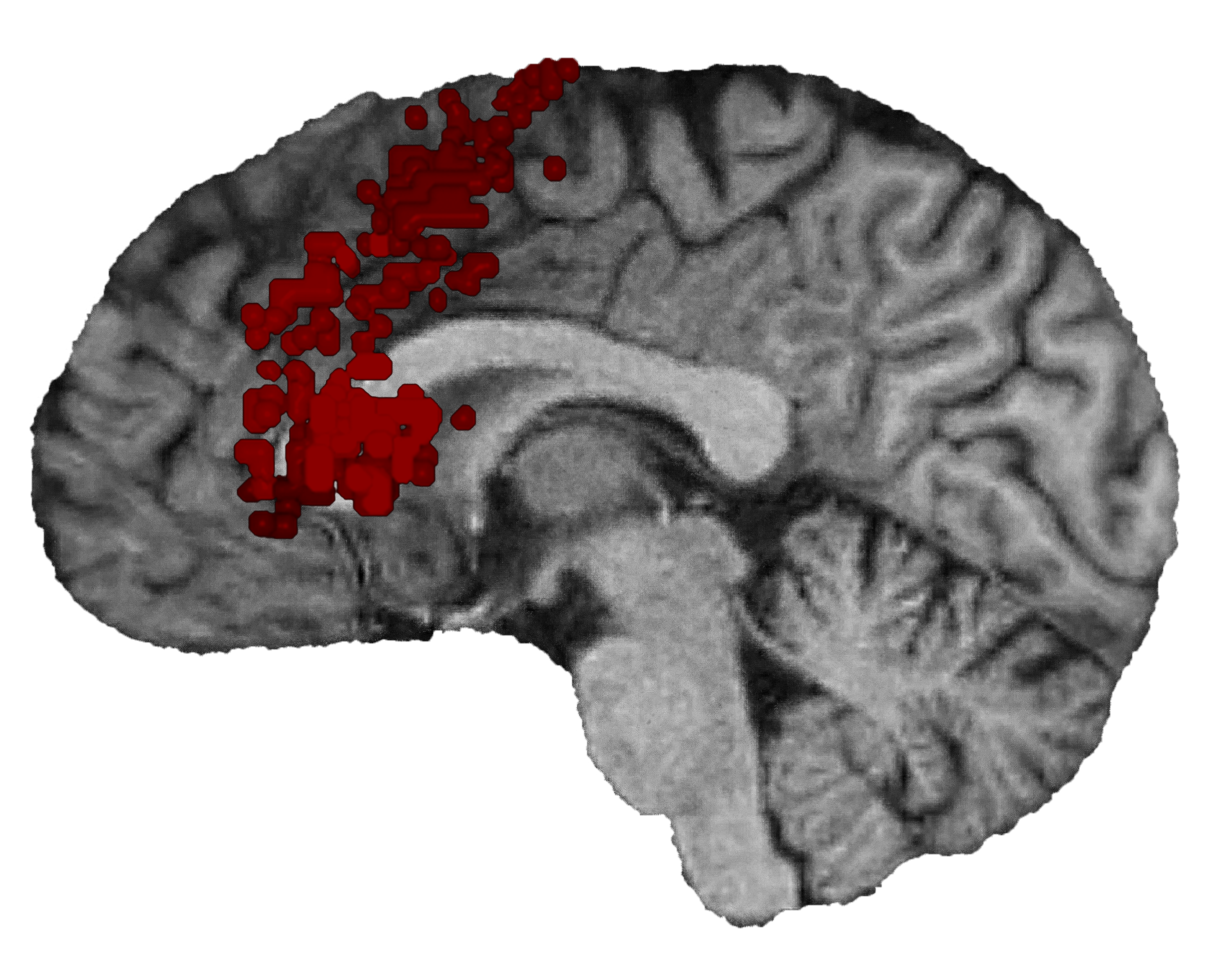
This creates a self-reinforcing feedback loop between perception and identity: what you notice changes, which reinforces who you’re becoming, which further changes what you notice.
Ironically, this mirrors what years of studying philosophy have driven into me.
Kant showed that we never see the world as it truly is, only as it appears through the architecture of our own mind, which is what Schopenhauer later distilled into a single line: “The world is my representation.”
You don’t see the world as it is. You see it as you are.
Thalamic and fronto-parietal attention circuits (no need to freak out) also play key roles in this process, functioning as gatekeepers that filter the millions of sensory inputs bombarding your brain at any moment (we only consciously receive a tiny sliver of the information our senses detect, less than 0.0005%).
When you establish a new identity, these regions begin filtering reality to match this identity, literally changing what you perceive. Change identity, and what the brain naturally sees as relevant changes. Changed perception thus follows, which is followed by changed actions, and the loop repeats.
This naturally leads into a discussion of the subconscious mind and its role as a filter/doorway to your conscious awareness, but that is for another time.
Research in neuroplasticity (your brain’s ability to rewire itself) reveals that repeated thought patterns and identity affirmations actually strengthen neural pathways, making them more efficient and automatic over time. In other words, people are naturally drawn to pathways of least resistance, and with time, shift who they are and what they think to align with those pathways.
This explains why sustained identity shifts eventually require less conscious effort—the brain will physically reorganize itself to support your new self-concept.
I will be discussing the specifics on how to do affirmations and how I’ve used them as a tool for identity shifts in another newsletter. However, what needs clarification now is that affirmations extend far beyond the simplistic notion of “shouting things in the mirror” or merely “writing things about yourself that don’t exist.” The methodology is considerably more sophisticated and neurologically sound, but again, that’s for another time.
Additionally, there is the default mode network (DMN). Responsible for self-referential processing and narrative creation, it creates your sense of “I” and “me” in the background, and adapts to incorporate your evolving self-concept into your personal story, gradually making your new identity feel more natural, real, and “true.”
The last thing I’ll mention here, since this particular letter isn’t dedicated to neuroscience, is the importance of these specialized cells called “mirror neurons.”
When we observe others embodying traits we aspire to develop, these remarkable little bastards activate as if we were performing those actions ourselves. This literally creates a neural template for new behaviours aligned with our desired identity.
Kinda fucked.
This also explains why surrounding yourself with people who already perform many of the behaviours you aspire to normalize accelerates the transformation of identity.
Your brain doesn’t just passively record the people you surround yourself with; it rehearses their patterns in real time at a neural level, creating pathways that make these same behaviours more accessible to you (I love being a nerd).
But those same pathways only take root in climates that match your identity’s setting.
So, who are you surrounding yourself with?
Anyway, enough neuroscience (for now).
Guarding the Dial
So, if you identify as someone who prioritizes their health, suddenly you notice available gym hours on the calendar rather than Netflix binges. Protein options on the restaurant menu jump out as if they were highlighted, while donut ads and weed shops seem not to hit as hard anymore, stripped of their former magnetic pull.
Identify as a respectful partner who honours boundaries, and suddenly you’ll find the psychological bandwidth to perceive what your partner actually needs rather than projecting your own fears. The drama and bullshit that once seemed inescapable—the fights, the intensity, the chaos—begins to look increasingly foreign and unnecessarily exhausting.
Lesson? Guard the dial with your fucking life.
This is a common trait among all successful people and the greatest minds. Like me staring at the mirror with blood streaming down my face, they’ve witnessed firsthand the raw and devastating violence of self-sabotage. They deliberately cultivate positive identity and belief layers within their inner world, which propel them into a positive cycle. And they viciously guard their minds to maintain this, with the vigilance of someone who has survived their own destruction.
They quickly dismiss negative or draining talk. And this isn’t because they are fragile, but because they’ve witnessed the (sometimes devastating) truth behind the interconnectedness of the inner and outer world. They have recognized that any attack on their psyche could quite literally ruin their life.
I personally cannot stand people who emit constant negativity over trivial matters—those who complain about the weather or critique a perfectly fine meal with odd disdain for failing to meet their standards.
This pattern of thinking emerges from what can only be described as a low thermostat setting—an inner climate where one lacks purpose, causing awareness to fixate on the most mundane elements of existence.
I refuse to allow these cold-adapted species into my terrarium (I realize this might sound harsh, but the stakes truly are high).
“If you don’t sacrifice for what you desire, what you desire becomes the sacrifice.”
—Unknown
The Mirage of External Change
Having established why identity is so important, I’ll now go on to explain how our identities actually precede and dictate our actions, and why any approach that ignores this fundamental truth is doomed to fail and wastes valuable time that could shape your future.
Consider what happens when your terrarium experiences an unexpected temperature spike from a fire breaking out: perhaps you stumble into someone who genuinely values you. Or maybe you hit an impressive winning streak at the blackjack table.
Your thermostat setting, however, remains unchanged. Your subconscious—your internal maintenance system that safeguards your psychological set point—immediately works to extinguish the fire. The room eventually cools back to its original programmed temperature, allowing the penguins to roam comfortably again.
This helps us understand why lottery winners often end up broke within years, why people sabotage relationships that “feel too good to be true,” and why temporary success without identity change invariably reverts to the same painful patterns. The system will always work to restore the thermostat level, whatever internally “feels like me.”
I deliberately chose a fire as the metaphor here because it perfectly captures the psychological reality of how positive external changes feel to someone operating from a low identity thermostat.
While the temperature technically rises in the terrarium—which in our framework would represent positive transformation—a fire represents something destructive and dangerous that demands immediate intervention. This mirrors exactly how your subconscious experiences unexpected success, love, or opportunity when your core identity hasn’t evolved to accommodate these realities.
What should feel like a blessing instead triggers the fire alarms of your terrarium: “This doesn’t belong here. This threatens the system’s stability.”
The Mind Swap
To make this more concrete, and to honour my status as a philosophy major, let’s conduct a further thought experiment that reveals the primacy of our inner world over external circumstance.
Imagine swapping the minds of a seasoned triathlete with that of a person struggling with obesity. More specifically, imagine you’ve swapped their brains and nervous systems. In the instant of the swap of their consciousnesses, nothing physically changes. They still have the same bodies, pantries, calendars, and social circles.
But their inner worlds—their thermostats—have also swapped.
Now, watch what happens over time. Within days, the triathlete-mind housed in the obese body begins making micro-adjustments: setting early alarms, scrutinizing nutrition labels, and creating training schedules. Her subconscious begins recognizing and seeking out patterns that align with her identity thermostat setting, gravitating toward her with the same certainty that water flows downhill.
Meanwhile, the obesity-patterned mind now operating the triathlete’s finely-tuned body grows increasingly uncomfortable with its surroundings. The disciplined structures that once felt natural to the triathlete now feel oppressive to the new inhabitant of their body. They begin skipping workouts, extending rest periods, and abandoning nutrition principles the triathlete once meticulously followed.
The magnificent body begins to deteriorate through identity incongruence. They lack the identity foundation necessary to maintain that body—they simply aren’t that person at their core.
Within months, their outer worlds gradually shift to match their inner terrariums. The triathlete-inhabited body now housing the obesity-mind finds its previously lush environment increasingly inhospitable to its former state; alas, the penguins have now returned to what feels like home. Conversely, the triathlete-mind housed in the once-obese body begins crafting an environment where rigour and performance naturally flourish. The penguins retreat; the lions arrive.
Physical change is a manifest symptom of internal change.
The True Value of Transformation
“The major life value is not what you get. The major life value is what you become.”
“What you become is far more important than what you get. What you get will be influenced by what you become.”
—Jim Rohn
As Rohn teaches us, the true value in achieving great things isn’t found in the things themselves. The external trophy is irrelevant. It lies ultimately in the internal transformation required to earn it.
The prize isn’t the prize. The person you become is.
As Rohn tells us, we shouldn’t be setting goals “for the outcome itself, but for who [we] get to become in the process.”
The pursuit itself reconstructs our inner terrarium, permanently elevating our thermostat to a setting where greater achievement becomes inevitable.
This explains why that ambitious classmate in high school who constantly spoke about becoming a millionaire despite having no capital, or the dedicated gym bro who smelled like a weight room despite having a mediocre physique, eventually manifested their dreams into reality. Their inner thermostats were set early on; it was simply a matter of time until the lions arrived in an environment designed for them to thrive. Their success was an inevitable outcome of their identity architecture.
Identity shifts first, outcomes follow.
Once you raise your inner thermostat’s temperature, you essentially already possess what you desire.
Time is merely the gap between your internal reality and the external life you ultimately create.
This is precisely why you shouldn’t wish for instant success or unexpected opportunities, such as that really hot girl or guy who you believe is too good for you, sudden fame, or a large sum of money falling on your lap. These are seen as psychological fires that your system will work tirelessly to extinguish. What makes you believe that you could actually sustain these things when your internal thermostat remains calibrated for an entirely different climate?
Without addressing your core programming, you are doomed to inevitably sabotage yourself back to equilibrium.
Building a Terrarium for Lions
My final point on thermostats is that the size of your zoo room corresponds directly to the magnitude of your goals. A larger terrarium naturally takes more time to reach the new temperature setting, and consequently, visible change emerges more slowly as new life forms arrive at a reduced pace.
Major changes—like transforming your physique, shifting your career trajectory, or finding a truly fulfilling relationship—are large-terrarium goals. These require full seasons to heat properly, not mere days or weeks. Yet, with this expanded capacity comes the ability to host apex predators. After all, a lion has no interest in roaming a well-decorated cubicle, no matter how many ornamental trees it contains.
The magnificent creatures that represent your highest potential demand a space worthy of their presence.
As your new environment takes shape, expect some changes: Old triggers lose the psychological grip they once had. Fast food joints no longer hold the same appeal. Relationships begin to dissolve, others transform.
Like the cold-adapted species, people accustomed to your old self may feel uncomfortable in your transformed space. Meanwhile, new people and fresh opportunities will begin to emerge, drawn to the climate you’ve methodically cultivated.
Expect periods of what I call “evolutionary boredom.” This is not a bug but a feature of your evolutionary process. It’s a sign that your neural circuitry is adapting to the elevated thermostat setting you’ve set.
Rather than a temporary state that you viciously fight to maintain, your new environment is becoming your baseline.
This is precisely the moment when most people fuck it all up.
They interpret boredom as a sign to drop the dial and abandon their progress, when it’s actually confirmation they’re successfully recreating their terrarium.
You will also experience occasional violent surges of resistance. These are nothing more than your thermostat’s maintenance crew running tests. Your subconscious is checking whether the old, comfy setting can reclaim the new environment.
These may manifest as intense cravings for the vices that once dominated your life (an old drug or fast food chain), existential questioning and spiralling of your new path (“is this all even worth it?”), or powerful impulses of self-sabotage. You might feel drawn to contact toxic exes, rationalize skipping a workout “just this once,” or abandon the healthy, productive habits that were foundational in your transformation. Perhaps the most seductive and insidious of these is the siren call back to comfort—that soft, padded room of mediocrity where nothing is demanded of you, and, consequently, nothing remarkable ever emerges from you.
Make no mistake, these moments are precisely the ones that separate those who merely visit transformation from those who claim permanent residence. This is where champions are forged and the mediocre retreat back into familiar territory. These are the defining junctures on the path to greatness.
Like myself facing that bloodied reflection, these critical confrontations must be endured and overcome. Despite every internal alarm screaming for the return to the comfortable cold, you must stand guard at the thermostat, refusing to allow the temperature to drop even one degree.
The Monkeys at the Dial
As your terrarium transforms and magnificent life begins to flourish, you’ll encounter another species entirely—one that doesn’t belong in your ecosystem but desperately wants to influence it. These are the people in your life who feel threatened by your elevated thermostat setting: jealous friends, envious family members, and anyone whose own cold, stagnant terrarium makes your growth feel like an indictment of their life choices.
Your transformation forces others to confront the violent reality of their own self-imposed limitations. Like a mirror, you reflect back their own unfulfilled potential—your growth forces them to confront the possibility of their own transformation, and what they’ve refused to pursue. This is exactly what most humans will do anything to avoid, even if it means sabotaging the progress—and even the friendship—of the very person they claim to care about.
These people are monkeys trying to fiddle with your dial.
They’ll show up with seemingly innocent comments designed to pull you back down to their temperature: “You’ve changed,” they’ll say with an undertone of disapproval. “Remember when you used to be fun?” They’ll invite you to “just one” night of your old, destructive patterns.
They will question your new boundaries. They will mock your disciplines. They will subtly undermine your progress with the precision of someone who knows exactly which buttons to push—this, unfortunately, is sometimes the person we once considered our “best friend.”
Understand this fucking clearly: their discomfort with your transformation is not your problem to solve.
And I know this can be deeply painful at times, especially when the monkeys are the precise individuals you love the most. But their inability to thrive in your new climate doesn’t obligate you to lower the temperature for their comfort. You wouldn’t allow actual monkeys into a controlled and delicately set up laboratory just to randomly fuck with equipment, yet somehow we permit the equivalent psychological vandalism from people who haven’t done the work to earn access to our inner world.
Once again, you must be ruthless in guarding your dial. These seemingly innocent monkeys will continue to reach for it until you make it clear that your terrarium is not a democracy. Your transformation threatens the story they tell themselves about why change is impossible, and they’ll unconsciously work to restore the familiar dynamics that allow them to remain comfortable in their own stagnation.
The moment you allow someone else’s insecurities to influence your thermostat setting, you sacrifice your future self for the comfort of people who aren’t even committed to their own growth.
Your terrarium. Your dial. Your life.
The River of Identity
Allow me to pose a final scenario to you.
Imagine a powerful, relentless river, flowing in a specific direction. You stand at the bottom of the river, gazing at a destination far upstream that you’ve been longing to reach. The only way to reach this destination is by way of water—you must swim.
Like any dedicated individual, you prepare extensively and become a masterful swimmer. You learn expert technique, you learn how to hold your breath for longer, you build incredible physical fitness, and you even buy really cool state-of-the-art goggles.
Recall: the destination is far.
Inevitably, you end up swimming into a harsh truth (see what I did there?)—that is, no matter how technically skilled you become, the river will eventually overwhelm you.
Even the strongest swimmer has finite endurance and will inevitably collapse beneath the power of the current.
This river symbolizes your identity. You are the swimmer, and your swimming efforts—paddling, training—symbolize your actions. The distance to your destination directly corresponds to the magnitude of your goal.
Now, let’s extend this metaphor. Imagine, somehow, you reach your destination. You’ve genetically modified yourself with fish DNA and grown gills to breathe underwater. In outer world terms, this might mean investing in a high-level personalized mentorship or rigorous accountability protocols.
However, there’s a final caveat. The destination is underwater, submerged in the very current you fought against.
Even with your gills, you must consistently swim against the current even after reaching your distant goal to maintain your position. The moment you stop actively resisting, you begin to drift downstream, back toward where you once initially stood.
The river never stops flowing against you.
This is why so many people experience the devastating cycle of achievement followed by regression. They mistakenly believe that once they’ve reached their destination, the work is complete. But the river—your identity—continues flowing with the same undiminished power.
The current shows no respect for titles, milestones, or muscle. FUL didn’t care that I had visible abdominal veins or the external markers of success. The current continued to pull with the same relentless force regardless of my apparent achievements.
The river will simply keep applying pressure, patiently waiting for the moment your vigilance falters.
The river of identity will never stop flowing in the direction it is already flowing in.
This explains why many who reach their goals eventually slide back to where they started. The transformation must be held at a deeper level, or else you will always surrender to the power of the river.
Let me ask you this: can you reverse the flow of a river? Can water be forced to run uphill?
You cannot change the physics of psychology.
To truly change your life’s trajectory, you must alter the river itself—reroute it completely so it flows in your favour. While you cannot reverse the existing flow, you can redirect the river.
Rather than swimming against the current, you must go to the source of it and create an entirely new channel that flows in your favour. This requires a fundamental transformation of your identity’s direction, addressing the core beliefs that shape its very source.
Only then will you find yourself effortlessly moving toward your goals. Only then will the violent struggle cease. Gone are the days when you battle upstream against your own psychology and neural wiring.
Instead, you will be carried—and even propelled—by the very force that once relentlessly opposed you, dragging you back to mediocrity.
A Recap
“Yesterday I was clever, so I wanted to change the world. Today I am wise, so I am changing myself.”
—Rumi
Let’s quickly review the core insights that separate those who transform permanently from those trapped in cycles of regression:
Your outer world is not the cause; it’s the effect. Your bank account, your body, and your relationships are all manifestations of your inner thermostat setting. Adjust the dial within, and reality must follow.
Identity governs everything else. The hierarchy is non-negotiable: Identity → Beliefs → Emotions → Actions. Skip the foundation and watch your house of change crumble within months.
Expect the lag and guard the dial ruthlessly. There’s an inevitable delay between internal shifts and external manifestation. The “lonely chapter” isn’t something wrong with you. You’re not weird (but you are an exception for even reading this far, so maybe you are weird—in a good way). This is proof that the system is working. This is where champions separate from the mediocre.
Your brain will test you. Resistance, boredom, and sabotaging impulses are all human. They’re your thermostat’s maintenance crew checking if the old setting can reclaim control. If you can pass these tests, the new temperature becomes permanent.
The river always wins. You cannot swim upstream forever. Stop fighting the current of your identity and redirect the entire river instead.
The Path Forward
Okay, so I hadn’t planned on writing this much for my first newsletter, but apparently, my fingers had other plans. I should probably stop.
I’ll be sure to make my future ones more bite-sized (I hope).
Identity, then, is something you both discover and create. It is a deliberate calibration of your inner thermostat that drives every outcome in your outer world. It is now your job to create your new identity—to reroute the river itself.
“Past-you threw a boomerang that present-you must catch now. Present-you is throwing another that future-you will catch. Make sure the throw is a good one.”
—Unknown
The bloodied reflection I once faced was catching the boomerang thrown by a younger version of myself who believed he deserved punishment. Today, I’ve thrown a different boomerang entirely—one of self-compassion, excellence, and deliberate creation. Future-me will catch that one instead.
The question here becomes: what boomerang are you throwing right now? Will your future self thank you or curse you for what you’ve set into motion?
The reflection staring back at you is both your creation and your creator.
I hope this has provided some clarity. The purpose of this newsletter was to set the foundations for the others yet to come, which explains why I haven’t given superficial “tips and tricks” that you’ll often see in this area of the internet.
I will be dedicating entire future newsletters to the specific actions, techniques, protocols, and frameworks I employed to change my identity, and I’m genuinely excited to share the unfiltered depths of this transformation in future newsletters. I have a lot more to say about a lot of things. But for now, I’ve said enough.
I’m sure this alone will be enough food for thought until we meet again.
For those looking to transform their terrarium—to create an environment where magnificent life thrives rather than merely survives—go ahead and follow my Substack.
The path I’ve walked from self-destruction to self-creation has revealed patterns and principles that I am sure transcend my own personal experience, applicable to anyone seeking genuine transformation.
And for anyone not just seeking tactical insights but rather simply curious about the existential musings of a philosophy and neuropsychology student with an extreme tendency to overthink, this may also be a good place to stick around. I’ll be writing about these things, too.
Now stop swimming, and shape the river so that it flows behind you.
Thank you for reading, and I hope to see you here soon.
—Aamer
The uniqueness and quality of your content on IG stood out to me, prompting me to come here. I absolutely loved this and am excited for what's next. Thank you Aamer!!
This was a fantastic read